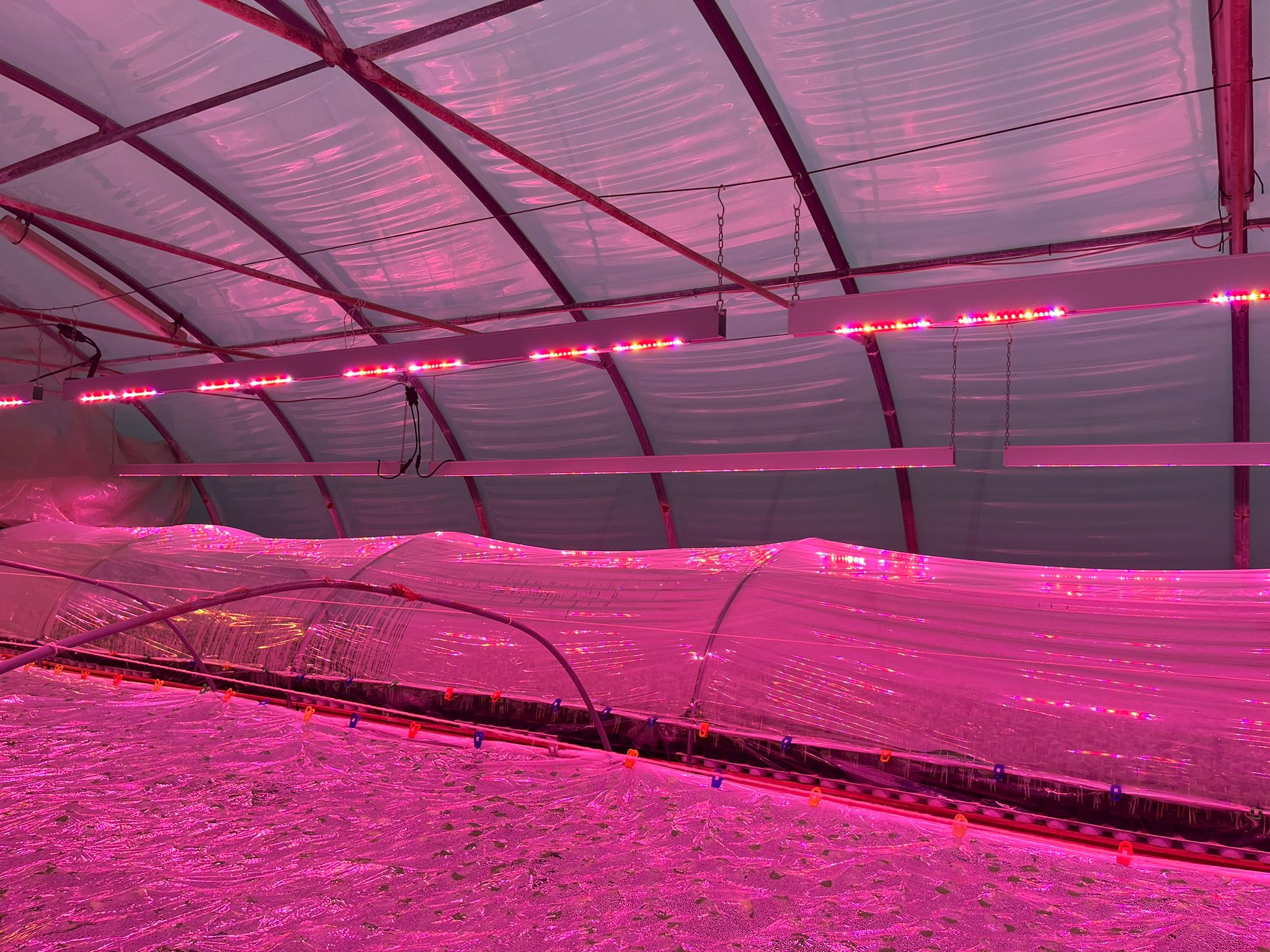
GREENHOUSE GROWING LAMPS: SHAPE AND DIMENSIONS
Let's start with a question that is far from secondary: the shape of LED lamps.
In the past, the shape of lamps depended on the shape of the bulbs; these could be pear-shaped, cylindrical, bulb-shaped, or tube-shaped, but they all emitted light in every direction, which is why all lamps were equipped with a reflector.
LEDs, although of various sizes and power, all have the same shape and all emit light in a semi-spherical direction. Consequently, they are more efficient when coupled with optics rather than reflectors, and the lamps are more economical if made in a compact shape: round, square, or rectangular.
Many manufacturers, however, either for imitation or to continue using the old bodies, have started and continued to produce LED lamps with the same shape and with the same reflectors as the old light bulb fixtures.
In the specific field of greenhouse lighting, many compact LED fixtures have been designed and built to imitate the old HPS lamps, but this simple solution has often led to mediocre results.
In Southern European latitudes, the average use of artificial lighting in greenhouses is about 2000 hours per year, and the cost of energy consumed, over 10 years, is 4-5 times the cost of purchasing the lamps. Under these conditions, saving 15-20% by purchasing a compact LED lamp can lead to a loss of 9-10% energy efficiency and 10-12% potential increase in production, which means spending, over time, 15 times the savings.
On the other hand, the proof of the above is quite simple.
1) The compact lamp heats up 30-40°C more than a linear one and it is mathematically obvious that LEDs lose about 1% efficiency for every 6°C increase in temperature.
2) Linear lamps, arranged in a continuous row, provide perfectly uniform lighting, even when positioned just above the crop; compact lamps, even if equipped with optics, require taller greenhouses and in any case do not achieve the same uniformity.
3) A compact LED lamp, equipped with optics to improve light distribution, loses 9-10% of luminous efficiency compared to a linear lamp which therefore does not require optics.
4) Reducing the distance between the crop and the lamp reduces light dispersion and improves heat recovery, always useful in greenhouse cultivation.
5) The life of LEDs and drivers depends on operating temperatures; the higher they are, the shorter their lifespan. Consequently, a compact lamp has a shorter lifespan than a linear one.
These 5 advantages of linear lamps and in particular of LUXLED EcoBars , compared to compact LEDs, lead, with the same energy consumption, to increases in production of 15-20%, and an operating life that is almost double.
Given that linear LED lamps are much better than compact ones, what are the optimal sizes? Obviously, it depends on the greenhouse, the crops, and the latitude. In Central European countries, considered to be at the forefront of this sector (the Netherlands, Belgium, and Poland), the average power of artificial lighting in greenhouses is 35-40W/m2 for flowering crops and 60-65W/m2 for the most common vegetables: cucumbers, peppers, and tomatoes.
In Northern Italy these values can be reduced by 1/3, halved in Central Italy and reduced by 2/3 in Southern Italy, resulting in a minimum of 12-13 W/m2 and a maximum of 40-42 W/m2 . Considering that it is uneconomical to produce LED fixtures for greenhouses with power lower than 200-240W, we can consider linear lamps with a length of 3 to 5 m and a power of 240 to 320W to be optimal. Each of these can cover, depending on the area and the type of cultivation, from 8 to 20 m2.